

AUSTIN, Texas (CN) - As Texas's biannual and 140-day legislative session came to an end on Monday, Republican lawmakers had run up the scoreboard, passing a range of conservative priorities.
On everything from cannabis to abortion, it was a banner year for conservatives in the Lone Star State. And perhaps nowhere is that truer than in the realm of education, where Republican Governor Greg Abbott finally succeeded in his yearslong quest to enact a school voucher program.
Vouchers and the Ten Commandments
When lawmakers returned to Austin in January, they had specific orders from Abbott and Lieutenant Governor Dan Patrick: Create a school voucher program to rival those of other states.
Unlike in previous sessions, Republican lawmakers this year answered the call.
Senate Bill 2 is a $1 billion program that diverts state funds to families seeking to send their children to private school. Any school-age child will be eligible to receive approximately $10,000 in an "education savings account," to pay for tuition and other education-related expenses.
Even for conservative Texas, SB 2 was a big ask. School voucher plans have taken heat not only from big-city Democrats but from many rural Texas Republicans, where school districts are major community institutions (and major employers). Indeed, some of the strongest support for vouchers came from out-of-state, including from Pennsylvania-based billionaire Jeff Yass, who poured money into the pro-voucher fight.
But school vouchers did see strong support from conservative advocacy groups in Texas, including the Christian nonprofit Texas Values. Jonathan Covey, a policy director with the group, argues SB 2 puts parents in charge of their kids' education.
"This is the largest program ever started in the United States," Covey said in an interview. "Texas started with the largest amount of money and it is going to create over 100,000 educational savings accounts."
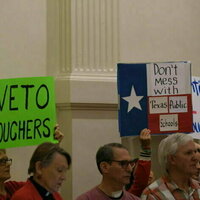
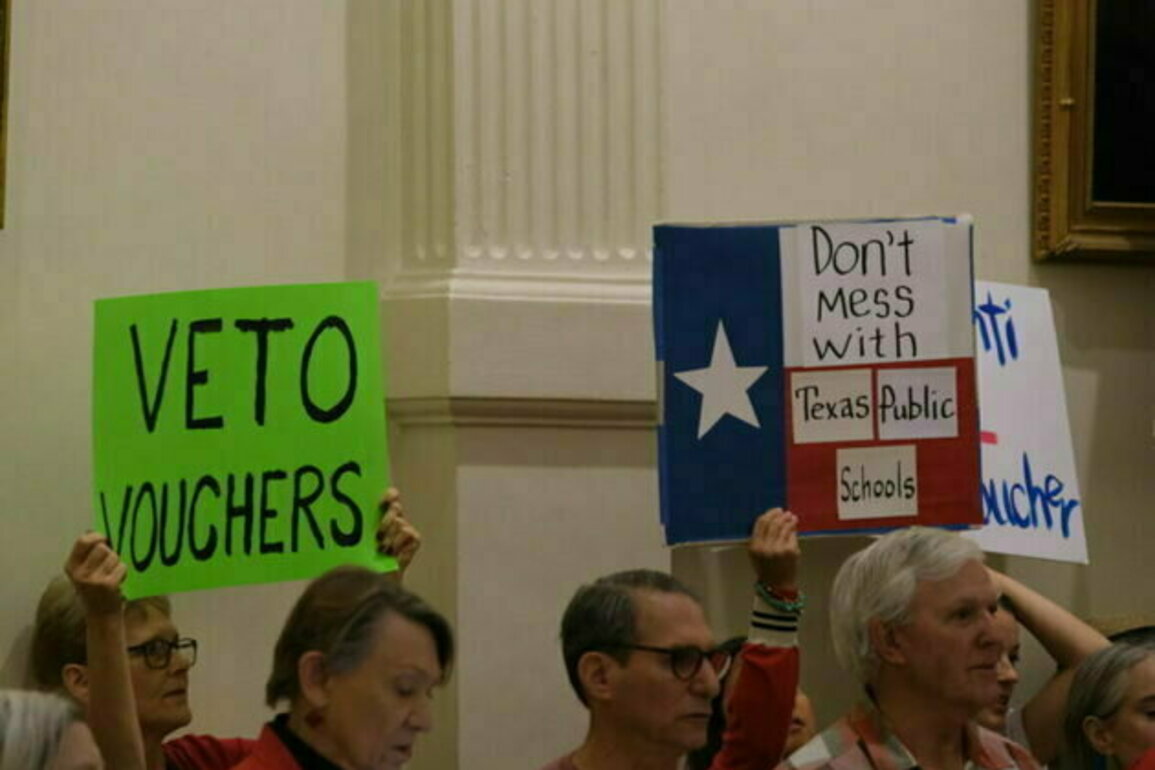
But public education advocates, school teachers and many parents fiercely opposed SB 2 at every turn, including during one committee meeting in March that lasted nearly 24 hours.
Among the opponents were Clay Robison, a spokesperson for the Texas State Teachers Association.
Robinson argues public tax dollars should stay at public schools. In a statement, he said SB 2 would do significant damage to public education.
"The result will be more underfunding in our public schools with higher teacher turnover, larger classes and insufficient resources for those classes," Robison said. "The ultimate victims will be school children, most of whom will remain in public schools."
In the end, though, opponents were unable to kill SB 2, a top priority for Abbott.
Lawmakers passed the bill, and Abbott signed it in early May. The law will go into effect in September, with the first round of voucher funding slated for the 2026-2027 school year.
Just as controversial was Senate Bill 10, a top priority of Lieutenant Governor Dan Patrick. That bill, now also law, requires a display of the Ten Commandments to be placed in every public school classroom.
Emily Witt, spokesperson for the progressive Texas Freedom Network, says SB 10 is unconstitutional on its face and puts teachers in a complicated position.
"I cannot imagine going to work every day and being told that I have to answer questions about the Ten Commandments," Witt said.
Covey, the Texas Values policy director, was a supporter of SB 10. He says the Christian document was foundational to the laws and history of the United States and should be recognized as such.
"It's not religious instruction," he said. "It's civic recognition."
As SB 10 awaits Abbott's signature, groups like the American Civil Liberties Union have announced their intention to sue. They saw the measure is a clear violation of the First Amendment's establishment clause, which bars the government from favoring a single religion. Even so, Mark Jones, a fellow at Rice University's Baker Institute for Public Policy, told Courthouse News that the message the bill sends is more important than whether it ultimately gets upheld in court.
"Of the priority bills, that is the one most likely to encounter legal headwinds," Jones said.
School vouchers and Ten Commandment displays are just some of the conservative changes coming for Texas education in the wake of this session. Governor Abbott is also expected to sign Senate Bill 11, allowing schools to offer time for prayer or bible reading, and Senate Bill 12, which bans diversity, equity and inclusion policies in K-12 public education.

Abortion exemptions and wrongful death claims
Officials in Texas have already strictly limited abortion and launched criminal investigations of patients and doctors. But Republican lawmakers this year again took aim at the procedure, sending Senate bills 31 and 33 to the governor's desk.
Senate Bill 31 spells out medical exceptions to the state's abortion bans, clarifying that doctors can use "reasonable medical judgment" to determine if an abortion is medically necessary. Notably, SB 31 does not provide exemptions for rape, incest or fetal abnormalities. Nonetheless, the bill received bipartisan support, as it followed a disturbing trend of physicians refusing to provide the procedure prior to full-on health emergencies.
Senate Bill 33, meanwhile, sparked opposition from Democrats. Taking aim at Texas' big liberal cities, the measure prevents municipalities like Austin and San Antonio from helping abortion seekers with money, transportation, lodging, food or child support.
A third bill, Senate Bill 2880, would have allowed anyone to sue manufacturers and distributors of abortifacient drugs. It also would have authorized the Texas attorney general to bring wrongful death claims on behalf of aborted fetuses. But that measure, from hardline anti-abortion state Senator Bryan Hughes, died in the House after missing a key deadline.
Burning up a booming cannabis market
At the start of the session, Lieutenant Governor Dan Patrick made banning THC products a top priority.
Those efforts have sparked a debate in Texas over what adults can put in their bodies, driving a wedge between socially conservative Texas Republicans and more libertarian-minded ones.
Although marijuana remains illegal in Texas, a 2019 bill legalized the cultivation and sale of hemp. And while lawmakers in that bill imposed limits on THC, they didn't target analogs like delta-8 THC that can provide nearly identical effects.
The result: one of the strangest marijuana markets in the country, where consumers can purchase intoxicating hemp sodas, candies and vapes at just about any convenience store. That freewheeling market operates parallel to a strictly regulated medical program for low-THC products. Fast forward seven years, and this gray market has exploded into an $8 billion industry. Patrick claims the products are being sold to minors, causing significant harm and even killing people.
"This is serious business," Patrick said at a viral press conference last week as he displayed snack products containing THC. "This is not Dan's folly. This is not Dan's priority. This is to save an entire generation from being hooked on drugs."
Patrick and his allies went after this market with Senate Bill 3, which further restricts cannabis products and imposes new penalties for possession, manufacture and sale. Consumables containing only CBD, a nonpsychoactive compound found in cannabis, will remain legal.
When SB 3 was first received by the House, the relatively more liberal lower chamber reworked the bill to allow some THC products, to be regulated by the Texas Alcoholic Beverage Commission.
House allies of Patrick then amended it, changing the bill back into a total ban.
"The compromise that the House proposed was insufficient in the eyes of the lieutenant governor," said Mark Jones, the Rice University researcher.
Abbott has not yet signed SB 3. In fact, he's been remarkably tight-lipped about his views on banning THC. Nonetheless, with the session now over, focus has shifted to whether the governor will sign proposals like this one.
With SB 3 just a signature away from becoming law, the bill has prompted fear and confusion among consumers and small businesses that use or sell these products.
That includes Hayden Meek, owner of the cannabis store Delta 8 Denton in the college town of Denton, Texas.
"People are calling in scared, not because they're hooked to anything, but because they finally found something that works for them," Meek said, echoing concerns he says he's heard from others in the industry. "It is such a widely useful plant, from helping somebody who doesn't have an appetite feel hungry to helping them with chemo[therapy] and anything in between."
And while the state's Compassionate Use Program is open to those with cancer, the THC levels in these medicines is far below what they'd find on the street.
With so many of the Abbott's priorities becoming law, it is hard to see him calling lawmakers back for a special session before they return for another 140-day session starting in January 2027. However, nobody can predict what the rest of 2025 and 2026 hold for the Lone Star State.
Source: Courthouse News Service